

More Human Than Ever: Retooling Humanity in the Age of AI
As AI reshapes everything from how we work to how we communicate, a surprising truth is emerging: our most valuable skill is our humanity. This piece explores why the future belongs not to those who compete with machines but to those who learn how to be more human than ever in the midst of a human-AI transition. Retooling humanity and enhancing ethical behaviour is key to succeed.
1/26/20262 min read
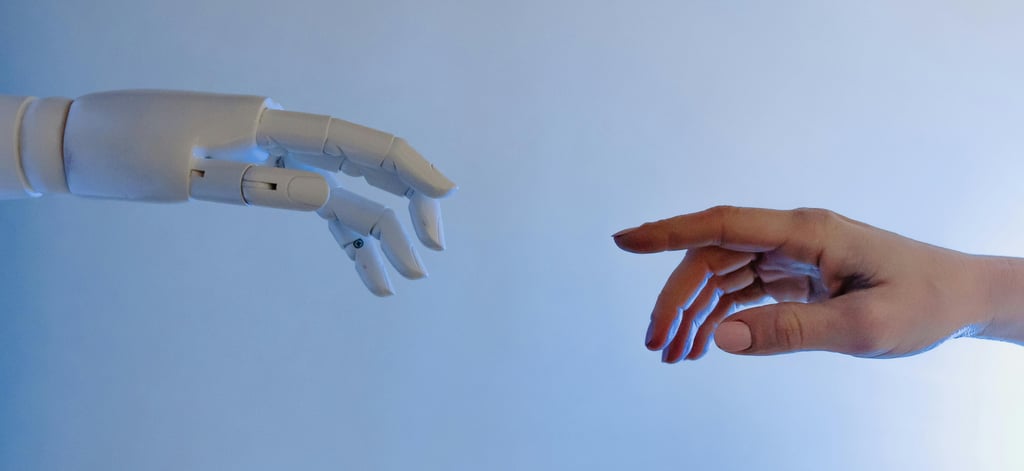
The rapid ascent of Artificial Intelligence (AI) has triggered a paradoxical shift in the global workforce: as machines become more proficient at processing data, humans are being forced to become more proficient at being human and ethical than ever.
We are currently navigating a "displacement effect," where specialized software and industrial robots disrupt roles from production lines to white-collar accounting. However, history suggests this is only half the story. As economists Daron Acemoglu and Pascual Restrepo argue, the "reinstatement effect" - the creation of entirely new tasks where human labor holds a comparative advantage - is the vital counterbalance. The real challenge isn't just a shortage of jobs; it is a potential shortage of meaning and the urgent need to retool our species for a high-augmentation era.
In Canada and beyond, the automation risk is starkly uneven. While generative AI (GAI) threatens to automate nearly 56% of occupations in sectors like transportation and warehousing, educational services remain remarkably resilient at 3.1%. The dividing line is no longer just blue-collar versus white-collar, but rather the "automatability" of specific tasks. GAI can draft a press release, build a website, or summarize a database, but it remains stubbornly human when faced with strategic judgment under ambiguity, ethical framing, good taste, and leadership. As we move toward 2030, the most valuable professionals will be those who treat AI as a "quiet force multiplier" while doubling down on human-centric skills like sense-making and relationship choreography.
Retooling for this future requires a shift from content production to "communications architecture." If low-level execution is being automated, then high-level "reputational stewardship", "context sensing", and ethical behaviours are becoming the new gold standards of human capital. Consider the global phenomenon of Bluey. The cartoon is, in many ways, a masterclass in the very skills we must now prioritize: empathy, patience, and navigating complex social dynamics. In a world of cold algorithms, the ability to "read a room," identify hidden incentives, and provide ethical clarity is magnetic. We are seeing a polarization of work where the "human-in-the-loop" isn't just a supervisor, but an interpreter who translates machine logic into humane action.
Ultimately, the future of work depends on a delicate mixture of new technologies and how they change the "task content" of our lives. Governments are already pivoting, treating high-quality scientific datasets as national strategic assets, yet the real "up-skilling" must happen within our own interpersonal toolkits. True charisma in the AI era is not a performance; it is emotional regulation under pressure and the ability to say, "Here is what we will not do." By refining these "deep human skills"- negotiation as empathy, influence without authority, and ethical gravity - we ensure that technology doesn't just replace us, but reinstates us into a more meaningful, and paradoxically more human, era of productivity.
Updates
Get your tech and AI news summarized in minutes.
Alerts
© 2025. All rights reserved.