

A Journey from Leonardo Da Vinci to Biomedical Engineering
How do you see inside the human body without ever making an incision? For Dr. Caroline Boudoux, professor in the Engineering Physics Department at Polytechnique Montréal, that question became the driving force of a career that stretches from a childhood spark to groundbreaking research in biophotonics. Her work uses light to reveal what the eye can’t, reshaping how we diagnose diseases. In this feature, we follow her unconventional path from early curiosity to MIT, to leading-edge innovations and a new book demystifying the PhD journey. It’s a story about science, serendipity, and the power of asking better questions.
10/17/20252 min read
Most of us never think about what is happening beneath our skin, how tissues shift, how blood flows, how cells behave. We rely on technology to reveal what the human eye cannot see. But behind every medical image that guides a diagnosis, there is a scientist who once asked a deceptively simple question: how do we see what the eye cannot see?
For Dr. Caroline Boudoux, professor in the Engineering Physics Department at Polytechnique Montréal, that question came early, at the age of five, during a visit to a Leonardo da Vinci exhibition. While most children were captivated by flying machines, she was drawn to something else, the inner mechanics of the human body. That moment, vivid and unexpectedly formative, planted a lifelong fascination that would eventually take her from Quebec City to MIT and into the field of biophotonics, the science of using light to explore the body from within.
Her path was not linear, nor was it planned. Boudoux describes her career as a combination of ambition, thoughtful work, well-timed mentorship, and serendipity. What stands out is the way she embraced each turn, a research opportunity, a book idea, a chance to share what she had learned, as a way to expand her expertise and refine her sense of purpose.
Boudoux is known for pushing the limits of medical imaging. Her work in optical coherence tomography has contributed to the development of faster, sharper, and more accessible diagnostic tools. But what makes her story compelling is not only the science, it is the mindset behind it. She believes knowledge should be demystified rather than guarded, that young researchers deserve greater transparency about graduate school, and that curiosity remains one of the most powerful drivers of innovation.
The Takeaway
Boudoux’s story connects scientific curiosity, research, and mentorship across generations. What began with a five-year-old fascinated by Leonardo da Vinci’s exploration of the human body eventually became a career devoted to making the invisible visible. Her work also offers young researchers, including women entering engineering and biomedical science, a clear example of where curiosity, persistence, and scientific ambition can lead.
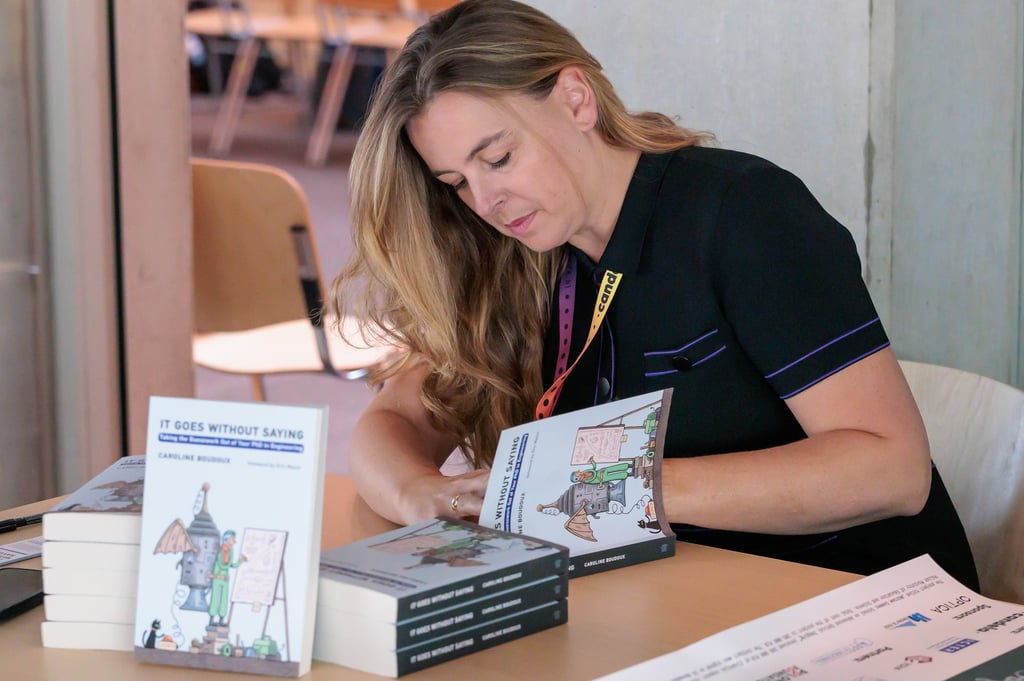
Her book, It Goes Without Saying: Taking the Guesswork Out of Your PhD in Engineering, reflects that philosophy. Part field guide, part survival manual, and part candid reflection, it explores the emotional and intellectual labour behind a PhD and the realities often left unspoken in academic training.
Updates
Get your tech and AI news summarized in minutes.
Alerts
© 2025. All rights reserved.